

“Reason Is and Ought Only to Be the Slave of the Passions”
– David Hume
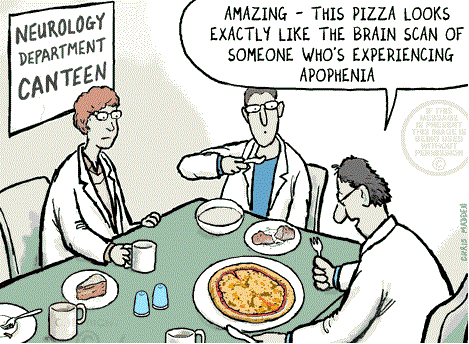
One of the most intricate group of activities in an organizational setting is the one that relates to human interaction and collaboration. In project space, there are many instances in which they come to life: Workshops, Trainings, Demos, Proof of Concepts, Brainstorming Sessions, Interviews, Group Dynamics, etc. That’s why multiple sources point out the leading causes of project failures to involve some degree human factor directly or indirectly. Productive collaboration in a professional setting is no easy feat. There is underlying tension, fear, divergence, distrust, contention, and ego playing parts to some degree, all undermining the creative process, problem solving, and decision-making.
There is a myriad of potential reasons that lead to poor collaboration, such as absence of skilled/specialized collaborators, inaccessibility to their consistent time, and subpar commitment/engagement. In the rare case that all these are in place, there is still a high chance that things won’t go as planned.
Another way projects fail might involve direct exchange of information, mostly written and verbal, more specifically, involving poor Logic and Reasoning, or lack thereof. Mostly overlooked or ignored, due to their common and mundane presence in our lives, but also due to their “hard to detect” nature, these deficiencies can dig project an even deeper hole.
ACAI BOWL:
As I walked down Yonge Street few days ago this month of June, at 3PM, at 32ºC, I was looking for an ice-cold drink or something to ease the heat. Many stores I passed by, until one caught my attention, for its outdoor banner in particular. I stopped in front of this Acai parlor with a standing sign depicting a well dressed woman under what seemed to be a quote of hers: “Toronto Best Acai Bowl”, it was Meghan Markle. I pondered for a minute: a celebrity saying something positive about a product while standing next to it is nothing new, I understood it was publicity stunt. But it felt random, something was odd. I knew it could be catchy to some, but it felt artificial and vague to me. Maybe because of its broad statement.

At the time, I remember reading an article about Logical Fallacies and Biases, their structure, how they are employed with a desired intent in mind. Also, how they functioned as mechanism for argumentation and debate. Amongst these was: Argumentum Ad Verecundiam — when an individual or group of individuals with status, wealth, or social position is summoned to claim, reinforce, and relay an opinion on a topic on which they are not an authority.
Under this fallacy, a broad statement can be intended to become the proclamation of the truth, a self-evident argument. The direct translation from Latin to English is Appeal to Authority ( sometimes: Appeal to False Authority). The connection between this fallacy and the sign at Acai store was more apparent now. The so-called celebrity, whose authority on the topic (Acai) is questionable, vouches for the product sold in that store. I still had more questions than answers, most hovered around the whether she was an Acai connoisseur I wasn’t aware of, or if there is even such thing.
However, I transitioned my thought from that to my true interest behind the queries: were there instances and occurrences such as those in Organizational Environments ever, and what potentially scenarios were out there. Enterprises are a part of a complex of network of clients, partners, and competitors, overwhelmed by the everlasting need to change and reinvent their It’s just natural to assume, then, that these Logical misuses and traps have their own place in the modern organizational world. Like every other social event, work is not immune to them, maybe it is even more prone and sensitive to them due to the chaotic biome in which they operate. The the heavily demanding speed through which changes are enforced, only adds to the fact of how easily faulty logic can be ignored.
ORGANIZATIONAL ENVIRONMENT
If we look inwards to our organization, it will not take too long to start identifying problems with the use of Logic and Reasoning. Look at complex transformation programs that amass companies nowadays, that topped with constant shift in vision and priority. The sheer volume of information received and conveyed daily is outrageous. It is not hard to imagine that part of these information will be broken, missed, distorted, truncated, etc. along the way, and that might be due to faulty reasoning. These obstacles to efficient communication contaminate work with biases, partiality, and, amongst many other things. Downstream results can vary: from misconceived products to catastrophes such as the one with Challenger in 1986.
One memory I have was when I led a discovery session aiming at identifying pain points within a process related to public communication. The main problem was observed on a high average response time. It was a 2h session with subject matter experts and business owners, all from the same team across different levels/roles. The idea was to be as holistic as possible allowing everyone to voice concerns, thoughts, and ideas. After 30 minutes in, most people were still awfully quiet. There was this one lady in specific who had a lot to say at first, but was quickly dampened by the manager and the coordinator. She dealt directly with the correspondences and most of times her opinions diverged from the manager’s. She started dwindling and the rest of the group stiffened. The session quickly became an interview with the manager, not all was lost but it wasn’t the best use of everyone’s time. I wondered how many useful points were not made that day.
This example is a single-discrete interaction of an Organizational Argument of Authority. Other cases might be a little more harder to detect. Hypothetically, requirement A can changed to B, or decomposed in A1, A2, and maybe A3 for good measure. These deviations might lead to defective products downstream, maybe a feature that no one knows what is for identified in testing phase, causing delays or extra customization costs. Now, extrapolate this incrementally by the number of interactions had in a single day, and observe that for the breadth of transformation pursued on a multi-year program and you might see yourself in a game of broken telephone.
In light of this, I decided to go back to my notes and start populating a list of fallacies, biases, and traps; also scenarios where they might take place happening, and potential counter-measures. There are in fact, dozens of types.

Here is an initial list of items:
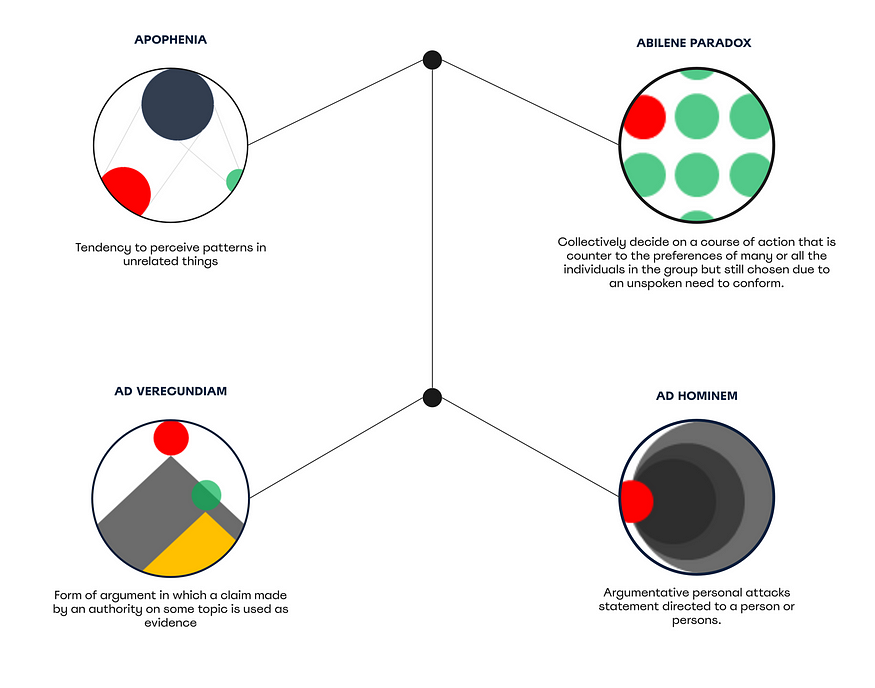
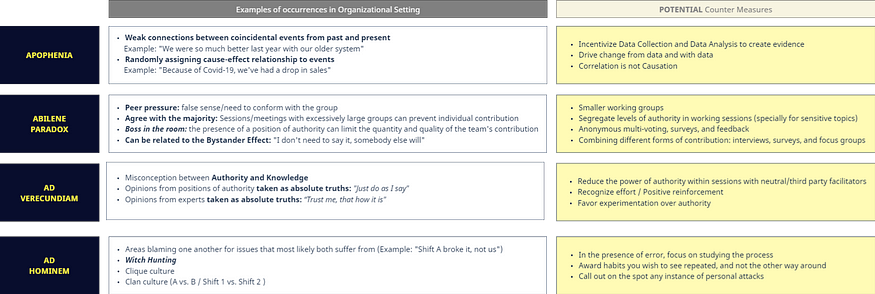
APOPHENIA: Tendency to perceive patterns in unrelated things or, formally described as: ‘the tendency to find meaningful patterns in meaningless noise’.
Examples in Organizations:
- Random connections between coincidental events from past and present: “We were so much better last year with our older system”
- Randomly assigning cause-effect relationship to events: “Because of Covid-19, we’ve had a drop in sales”
Potential Workarounds:
- Incentivize Data Collection and Data Analysis to create evidence
- Drive change from data and with data
- Differentiation between Correlation Causation
ABILENE PARADOX: Collectively decide on a course of action that is counter to the preferences of many or all the individuals in the group but still chosen because each person thinks they are the only one thinking differently.
Examples in Organizations:
- Peer pressure: False sense/need to conform with the group, because my piers might think something else of me.
- Agreement with the majority: Sessions/meetings with excessively large groups can prevent individual contribution, and participation concentrates on 10–20% individuals that are more vocal.
- Boss in the room: The presence of a figure of authority can limit the quantity and quality of the team’s contribution for fear of negative repercussions.
- Bystander Effect: “I don’t need to say it, somebody else will”, so choosing to quiet down expecting someone else what you have to say.
Potential Workarounds:
- Experiment sessions with smaller working groups.
- Segregate levels of authority in working sessions (specially for sensitive topics).
- Combine different forms of contribution: Multi-voting, Surveys, Anonymous feedback, Interviews, Surveys, and Focus Groups.
AD VERECUNDIAM: Form of argument in which a claim made by an authority on some topic is used as evidence.
Examples in Organizations:
- Propensity to mistake Authority for Evidence.
- Opinions from positions of authority taken as absolute truths: “I know it happens”.
- Opinions from experts taken as absolute truths: “Trust me, that’s how it is”.
Potential Workarounds:
- Introduce neutral/third party facilitators in working sessions.
- Recognize effort / Positive reinforcement on the spot.
- Favor experimentation over authority.
AD HOMINEM: Argumentative personal attacks statement directed to a person or persons.
- Culprit: Areas finger pointing each other for issues that most likely both suffer from (Example: “Shift A broke it, not us”).
- Clique culture / Clan culture: (A vs. B / Day Shift vs. Night Shift / Geography 1 vs. Geography 2).
- Witch Hunting
Potential Workarounds:
- Introduce Shingo Principles: In the presence of error, focus on studying the process.
- Award habits you wish to see repeated, and not the other way around.
- Call out instances of personal attacks.
In conclusion, the hard part might not be then in NOT committing these faults, but rather in identifying and addressing them, due to its inconspicuous nature. The first stage would be to create awareness to the problem and its many facets. At this stage the presence of a specialist could benefit/accelerate ideal.
Another key takeaway is not the dismissal of the use of Qualitative Assessment, since it has serious impact in the success of the project, but assimilating that humans can and will fail during the process. And one of the modes of failing is by improperly employing logic. Because of such, it is important to not assume opinions for its face-value, equating them to evidence. Power and authority should be leveraged to facilitate and ease discussions rather than create impositions.
Stories, anecdotes, and testimonials are the beginning of the journey rather than the end. They are the starting point of an investigative process that must follow. They must start a bigger discussion supported, as much as possible, by data as much possible. If not possible, limitations must be called out as constraints to meaningful conclusions, along with the level of uncertainty they generate.
 Antidea